The final book of the trilogy on army supply

The final  book of the trilogy on army supply
The third of my books on army supply

Thursday, 29 December 2022

Royal Arsenal Woolwich

The Royal Arsenal at Woolwich features often in my books  

My father attended the first Ordnance Officers course there following the end of #WW1. I call it the Class of '22. It was remarkable in producing eleven future RAOC Brigadiers, but also five future Major-Generals out of a total of less than thirty. A fellow officer recorded a vivid account of the rush to join up in 1914. I include both in Dunkirk to D Day. 

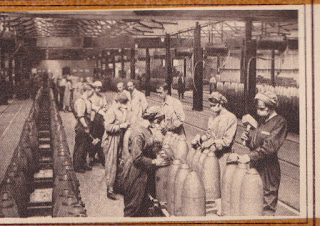
In WW1, through no fault of its own, the Arsenal couldn’t cope with the demands of war on an industrial scale. Alongside, Lloyd George in effect mobilised the whole of British industry to supply the war effort. I write that story in Ordnance. 

In WW2, the greater part of the RAOC presence at Woolwich was removed from the danger of enemy bombing to Donnington in deepest Shropshire. I tell the story with some first hand accounts in War on Wheels. 

The Arsenal played a key role in our manufacturing past. In the wake of the Crimea, it modernised and took on the latest technologies. I tell that story in How Britain Shaped the Manufacturing World.

I am delighted to see the detailed history of the Arsenal taking shape on Royal Arsenal History. 

With thanks to the RAOC archive


Monday, 26 December 2022

MacRoberts Reply is still selling

 I was asked to write this remarkable story by Story Terrace and the resulting book, written in conjunction with Phil Jeffs, was published in 2017 

Jeffs father survived the crash of a Stirling bomber in Denmark.

He survived with the help of the brave Danes who witnessed the crash and spent the rest of the war as a prisoner before enduring the long march home.

The aircraft was given to the RAF by Lady MacRobert as the Reply to Hitler for the loss of her three sons. Lady MacRobert was a great philanthropist and also instituted the MacRobert medal for engineering excellence. This links with my work in progress for it was awarded to the Lincoln team developing gas turbines. 

I was able through archival material to reconstruct what is by any standards a remarkable story drawing also on the work of Marion Miller and her book on the MacRoberts Cawnpore to Crowmar. Phil Jeffs begins the book with his father’s and his rescuers' vivid recollections of the crash. 

Seeing that sales of the book were still coming through, I reread the reviews and can see why!


Monday, 12 December 2022

North Africa 1943

 Excerpt from Dunkirk to D Day

On 3 April, Bill Williams (COS RAOC), accompanied by Dick Hunt, took off from Hendon in an American aircraft to Marrakesh via Prestwick. They slept on the steel floor of the aircraft. The itinerary began at Marrakesh where they stayed at the Mamounier Hotel, formerly a Sultan’s palace. They travelled on to Algiers where Bill met with General Humphrey Gale and, one of the Class of ’22, Wallace Pickthall. Gale was then Chief Administrative Officer to General Eisenhower’s Allied Forces HQ, Wallace Pickthall was appointed Director of Ordnance Services at Allied HQ and would gain a priceless insight into allied working for a seaborne invasion. Alan Fernyhough was serving in North Africa and so could see at first hand the qualities of the man which he described in his History of the RAOC:

‘Brigadier Pickthall was not the man to shirk this task even though he was shrewd enough to know that it was likely to get him more criticism than credit. He had all the knowledge and experience of Ordnance work necessary for the appointment, but his chief qualification was that he had qualities of personality and character most needed at that time. His transparent honesty, integrity, friendliness and sense of humour ensured the maximum co-operation. The Americans liked and trusted him. Even those who prided themselves on being hard-bitten, “Vinegar Joe” types found difficultly in keeping up the act. His loyalty to his own staff evoked from them respect, admiration and a determination not to let him down. Yet, he lacked that element of ruthlessness which must be available in such a ruthless war.'

I also write about the North African campaign in War on Wheels.

Friday, 9 September 2022

HM Queen Elizabeth II and the RAOC

  My father's archive includes correspondence with Buckingham Palace from not long after her Coronation exploring the possibility of her visiting the Corps of which she was Colonel in Chief. The exchange of letters concluded in 1957 with arrangements for a visit to Deepcut. 

The visit took place on 11 April 1958 and the Queen was hosted by Major General Sir Lancelot Cutforth as Director of Ordnance Services and my father, Major General Sir Leslie Williams, as Colonel Commandant. This is one of the photographs taken of the visit.

There is a film of the visit which I am sure is held at the RLC Museum. There are further photographs in my father's archive which is also held at the museum. 

Following the visit the Queen's private secretary wrote a letter of thanks saying how interesting the Queen and the Duke of Edinburgh had found it. The letter is reproduced in Dunkirk to D Day with permission of the Palace.

Sunday, 28 August 2022

The British Motor Industry

The British motor industry is one of my earliest memories. After leaving the army, my father became a director of the Rootes Group and he was one who definitely brought his work home. To a small boy it was the delight of the brochures for new models but also exotic characters from export markets who would come down to Sunday lunch, Emile Bustani being notable among them.


A poster from the interwar years

I have explored different aspects of the history of motor manufacturing in Britain in, now, four books. The first was War on Wheels about the mechanisation of the army in WW2 and in an article I wrote for The History Press. This was followed by Ordnance which shifted the camera to WW1 and, of course, the first appearance of the tank. I then moved my focus to people and I wrote about my father and the Rootes Group, but also Lord Nuffield, senior managers at Dunlop who contributed significantly to the war effort and a number of others in Dunkirk to D Day and my article on Civilian Expertise in War. The fourth book, How Britain Shaped the Manufacturing World, was a quest to discover the origins of the companies and how they fitted into the British manufacturing story. It is a story of larger than like entrepreneurs such as Lawson and Hooley working in creative tension with brilliant engineers
The British motor industry has so much to be proud of, not least its service in WW2. I quote from War on Wheels.

Bill Williams, now Deputy Director of Ordnance Services (MT) at the War Office, went to Chilwell that morning to lead a group of senior serving officers meeting, possibly for the first time, the newly called up members of the Army Officers Emergency Reserve. These latter included ‘Reddy' Readman who would take over as COO at Chilwell, Bob Hiam, who would command the depot at Old Dalby, Robby Robinson, who would command the depot at Sinfin Lane, Derby, and Dan Warren who would take a lead role in scaling, the dark art of estimating the quantity of spare parts needed to maintain vehicles in battle order.

Also on that Sunday in Birmingham the executives of the Nuffield Motor Company met to put into action the plans they had prepared for war. Through the various parts of the Nuffield Group it would over the next five year contribute aircraft and weapon production in addition to a great many vehicles. The remainder of the big five motor companies had been working with the Government on preparations for war, mainly the manufacture of aircraft. On that Sunday, though, the car plants themselves were placed on a war footing. The men who arrived for work the following day would be instructed to complete those cars already started, but then to leave the shop floor ready for war production. In many cases the contracts were slow in coming and the companies had to keep their workforces occupied one way or another; some had to be laid off. The motor industry, because it was set up to manufacture on a production line largely from metal and because it had a broad range of other skilled men, would be more than busy for the next five six years.’

Friday, 17 June 2022

Who made the kit supplied to our army?

In each of War on Wheels, Ordnance and Dunkirk to D Day, names of businesses appear which for me are laden with associations. They are names from childhood, from an earlier age. I knew the names, but so little about them. 

This sent me on a quest. I traced the origin of companies to their birth and young life. 

My great grandfather had exhibited at the Great Exhibition of 1851 and I found a copy of the catalogue. It was an astonishing event held through the summer in a vast glass building in London’s Hyde Park. In the catalogue I found many of the same business names but many more. 

I explored endless avenues and the result is a book How Britain Shaped the Manufacturing World. It has just been published by Pen & Sword. I hope you will find it as interesting to read as I did to write. Here are links to other blog pieces on the subject: Motor Industry, Clothing, 

I am now on a quest to discover what happened to those companies, for so many have faded from view: Vickers, ICI, Ferranti, Marconi, Plessey, GEC, John Brown, Hadley Page, AVRoe, Supermarine, Alvis… 
Some though have prospered: Rolls-Royce, Johnson Matthey, Glaxo, Unilever, Jaguar, Dennis, Babcock…
So, added to my quest for what happened, is the question: why did it happen?
For the defence industry, much of the ‘What’ is to be found in BAE Systems but also Babcock. Yet nothing is that simple. 


Sunday, 20 March 2022

COD Branston army clothing

In WW2 clothing was dealt with in a former pickle factory at Branston near Burton on Trent, to which it had moved from Pimlico in Central London. Harold Crosland, a businessman and TA officer from Berkshire who had won an MC in the First World War, would command the depot at Branston for the duration of the war. 

In WW1, the provision to the army of appropriate clothing was a huge challenge. Pimlico, near Victoria Station, was where army clothing production and distribution was centralised. The choice of further depots in places like Leeds made sense because they were near to Bradford and other places where the cloth was woven and the uniforms made up. The trench coat would become associated with the First World War. For these, Burberry used their patented Gaberdine waterproof material, and Aquascutum the water proof cloth that they had patented. The cotton mills of Lancashire had maintained their pre-war level of production with a workforce in 1914 of over 600,000. The rationale behind this was that the war was going to be short and Britain’s role would be that of armourer funded by its export earnings from textiles. As is clear, this is not what happened. What is odd is that the mills didn’t shed labour to where it was needed in the forces and armament factories. 

The story of Branston pickle is told on the Burton on Trent website.

By the end of the thirties man-made fibres had joined cotton and wool and so ICI, Courtaulds, Dunlop and British Celanese amongst others would supply alongside the mills of Lancashire, Yorkshire and Northern Ireland.

I write about the British textile industry and its role in two world wars in How Britain Shaped the Manufacturing World.

Ordnance tells the story of supply in WW1. War on Wheels focuses on WW2. Dunkirk to Day explores the lives of the leaders, most of whom served in both wars. 

Friday, 18 February 2022

150,000 blog visits

 For an historian, people finding interest in their research is reward enough. In May 2014, I found an incredible archive and since then I have endeavoured to tell its story.

I have now taking up a strand of my research for my next book, How Britain Shaped the Manufacturing World, to be published in June 2022

War on Wheels and Ordnance are available to buy from The History Press and Dunkirk to D Day from Pen & Sword, also from Amazon and good book shops.


Tuesday, 8 February 2022

Civilian Expertise in War - article in The Historian

 When I think of war, I immediately see men and women in one of three uniforms: Royal Navy, RAF and Army. My research over the past seven years into how the British army was supplied in two world wars tells a rather different story.

In my article I seek to explore the role played by civilians and civilians who temporarily became soldiers bringing with them skills and experience from the essentially non-military world. Rather than look at this in its generality, I focus on the story of a small number of individuals who ended up playing key roles.


My article is published in The Historian, the magazine of the Historical Association

I tell more of these men in my book Dunkirk to D Day 

Thursday, 9 December 2021

What next after War on Wheels?

 War on Wheels led me on a voyage of discovery not only into the work of the RAOC and REME in WW2, but also the significant role played by the British Motor Industry. This led me to explore the broader role of British industry in WW1, in Ordnance. From here it was people, and how so many brought expertise to the army from industry; I tell of the lives of such people and those leaders with whom they worked, in Dunkirk to D Day.

I have now grasped the industrial nettle and have spent the last two years exploring just where all these incredible companies came from. Their story I now tell in How Britain Shaped the Manufacturing World, which it to be published by Pen & Sword in 2022.


Friday, 26 November 2021

Dunkirk to D Day - as Social History

The book looks at the lives of a group of men born at the close of the 19th century who came together in WW2 when they led a task of monumental proportions.

Their individual stories cast light on Britain in the first half of the 20th century.

My father, Bill Williams, was born in a then pretty new semi-detached house in Dulwich in south London; his father was sixty but his mother was half that age. I record memories he left of his childhood, for example how he rigged up electric shocks to play tricks on his parents and how their washer woman was rewarded by a half pint of beer. He went to school at nearby Alleyns and recalled escaping German lessons by volunteering to clean the master's bike.

He left school at 14 when his father died and went to work as an office boy. At age 20 he grasped the opportunity to join a friend of his father to trade 'manchester goods' in East Africa. He wrote:

"I went on foot from Beira to the Portuguese border near Blantyre, seeking out trade and trading with the natives (sic) groundnuts and mealies. We had brought out with us bales and bales of ‘Manchester goods’, cheap coloured cottons, brass wire and beads." 

In the book, I add his encounter with a cobra and an oily colonial who offered any girl he wanted. Black water fever brought him back to England, but not for long. His next trip was rubber planting in Malaya. He would tell us as children stories of distributing quinine to his workers; he failed to mention the night he was brought home drunk in a wheelbarrow.

Those of the group who were old enough served through the Great War. Jack Omond wrote a revealing account of what life was like behind the trenches for Ordnance officers; I used extracts from this also in my book Ordnance. This is a little of what he wrote:

"From the great crowds outside the Dockyard and Arsenal gates to the tailor’s shops where leather buttons were exchanged at exorbitant prices for brass buttons bearing the regimental arms, work was obviously proceeding at great pressure. Recruits were to be seen in all stages of training and in all manner of garments."

The interwar years saw some men returning to jobs in industry, whilst others continued to serve in the army. My key narrator, my mother who was my father's PA in WW2, was born in the midlands lace making town of Long Eaton. I write of the industrial experience in my piece on Dunkirk to D Day - as Manufacturing History.

WW2 witnessed the mammoth task of re-arming the army for D Day after the loss of most equipment at Dunkirk. As part of this Bill Williams, as Controller of Ordnance Services, visited his opposite numbers in the USA and also built vital relationships with American and Canadian suppliers. My mother kept some wonderful diaries and I record some of these in my piece Dunkirk to D Day - as Travel History. 

In the post war years, civvy street beckoned Bill and some of his colleagues; others remained in the army before well earned retirement.

You can buy Dunkirk to D Day by following this link. If you would like to order a signed copy, please complete the contact form or DM me on twitter. 


Dunkirk to D Day - as Travel History

My mother kept diaries of the trips to USA, the Middle East and Africa which my father undertook as Controller of Ordnance Services. This is a little of what she wrote; there is much more in the book.

"We all boarded the plane, gosh my tummy felt strange inside, but it was all so thrilling…then came the take off. I was so afraid of feeling ill at this juncture, and crossed my fingers hard…thank goodness it didn’t affect me, I only experienced an enormous excitement...We had to draw the blinds of the plane; I suppose this is in case any of the passengers are spies, and on the look-out for gun sites etc. However, being me, I made up my mind I’d look out, so I peeped behind the blind. We taxied quite a long way on the water, till we came to a good long stretch in the estuary. Then the engines were rev’d up and we speeded up. The plane went at such a speed on the water, before taking off, that the water sprayed up each side like terrific wings, and then – we were up. Peeping though the window blind, I saw the tiny Irish farm houses, looking so sweet and peaceful nestling by the sea shore."

She goes on to describe stop offs in north Africa before his first views of New York. One year later they travelled to the Middle East and Africa to release equipment for the expected land war in the far east. She wrote some vivid descriptions not least of flying across the desert.

‘We flew over miles and miles of this type of country, then eventually sighted the sea. We approached the coast at a point in the Gabez Bay near Mareth, the famous battleground. I have never seen such a beautiful sight as the blue of the Mediterranean Sea near the shore. It is the colour of turquoise, clear and bright and shimmering. We flew for miles and miles in line with the shore and I just lapped up its beauty. I could see the date palm trees below, and the blue-green of the olive trees and the brilliant shining green of the orange trees. The General pointed all this out to me and said “remember this for your diary”.

"How can one write a sunset? I cannot paint it. The words are hard to find to describe the beauty of the sunset tonight. The sky a deep purple blue, lit by a solitary but brilliant star, and then on the horizon ten thousand rainbows rolled into one, red, orange, indigo, blue, purple so blended together that the sky looked like a little bit of heavenly painting - a miracle of beauty and splendour."

A war and twenty five years earlier, my father had traded in East Africa and planted rubber in Malaya  

Bill and Betty at Mombassa station; Bill was also photographed there in 1911.

You can buy Dunkirk to D Day by following this link. 

Dunkirk to D Day - as Manufacturing History

 Just as Lloyd George had in the First World War, in the  late thirties the army recruited men and, this time women, with the specific expertise needed. This time, though, it wasn’t just people, it was expertise itself. In the late thirties, setting up the brand new Army Centre for Mechanisation, the then Chief Ordnance Officer, Lt. Colonel Bill Williams, approached hundreds of civilian enterprises to ‘pick their brains’. 

In response to his approaches, he welcomed visitors from some of the leading British manufacturers: Sir Peter Bennett of Lucas, Harold Kenward of Dunlop, Bob Lillico of Lucas, Lord Nuffield, Sir William and Sir Reginald Rootes, Sir Patrick Ashley Cooper of the Hudsons Bay Company, Sir Patrick Hennesey, Sir Roland Smith and Stanford Cooper of Fords. 

Head of the list of civilians who brought their expertise to army service was Ronald Weeks, a director of Pilkington who had also served with distinction in WW1 and then in the territorial army. Crucially he was part of Management Research Group No. 1, which was a grouping of major companies including ICI, Lever Brothers, Standard Telephones and Rowntrees to explore modern management issues. 

A good many joined the RAOC from the motor industry, bringing, in particular, their expertise in distribution. I would highlight two men from Dunlop. Robbie Robinson, who set up the MT depot in Derby before taking over Feltham and then becoming RAOC Inspector overseas setting up uniform procedures worldwide. Bob Hiam set up the armaments depot at Old Dalby and went on to command the depot outside Caen in the month following D Day and then the depot at Antwerp for the final push into Germany.

Reddie Readman was a director of the English Steel Corporation both before and after WW2. He served in the Tank battalion in WW1. In WW2 he commanded the Army Centre for Mechanisation at Chilwell near Nottingham where he oversaw the growth in the number of army vehicles from 40,000 to 1.5 million.

In an article published in the Historian Magazine, I explore the role played by civilians and civilians who temporarily became soldiers bringing with them skills and experience from the essentially non-military world. 

My latest book, How Britain Shaped the Manufacturing World, explores the story of British manufacturing from the Great Exhibition of 1851 up to the Festival of Britain one century later. You can buy it by following this link and find out more about it on my blog  

You can buy Dunkirk to D Day by following this link.